Lead Research Agent
An orchestrator that researches eight companies in parallel with sub-agents, scores each against the ideal customer in code, and drafts a first email built on a verified finding.
- Agent Lab · sample data for FieldLoop
- Design & Engineering
- Agent Lab · 2026
Overview
Sales teams spend hours reading prospect websites to decide who is worth an email. This agent fans out one researcher sub-agent per company, four at a time. Each reads its company's site with tools, and returns structured findings where every buying signal has a verbatim quote and its source URL. Code checks every quote really appears on the page, scores the lead against the ideal customer profile, and only then does a writer draft a short, personal first email around one verified finding. Nothing reaches the CRM until a person approves it.
The Problem
AI SDR tools are known for confident, generic outreach built on facts they made up. A useful research agent has to be fast across many leads, stay on the right website, and prove where every claim came from.
- ▸Researching leads one by one is slow; doing it in parallel means isolating each worker.
- ▸Models invent or misattribute quotes, which is fatal in a cold email.
- ▸Lead scores must be explainable, not a number the model felt like giving.
The Solution
An orchestrator with isolated sub-agents, evidence checks and rubric scoring in code. The model reads and writes; code verifies and decides.
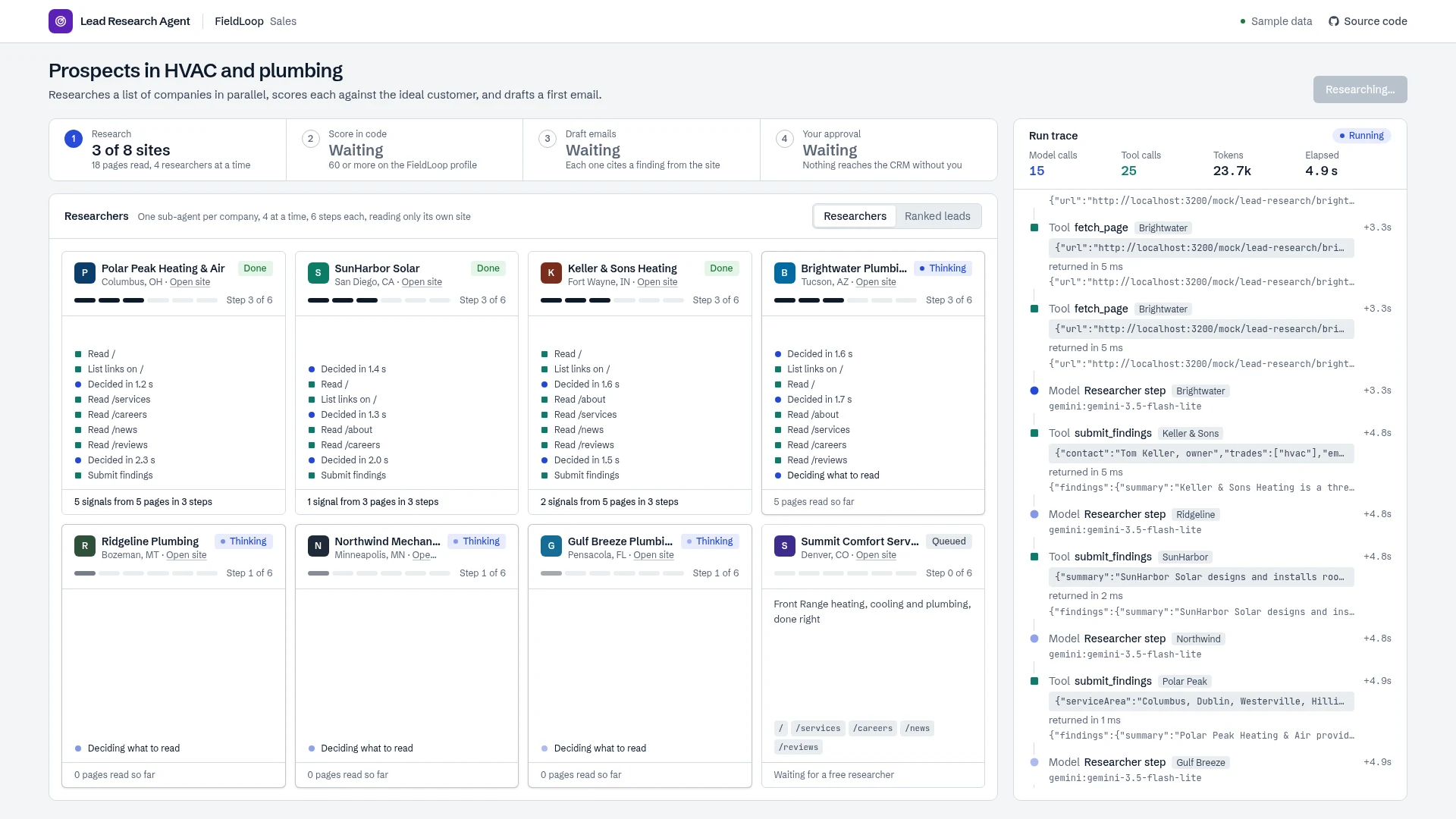
- ✓One researcher per company, four in parallel, each with its own conversation, page cache, six-step budget and tools limited to its own site.
- ✓Every quote is verified word for word against the pages the researcher read; misattributed quotes are re-pointed, invented ones dropped.
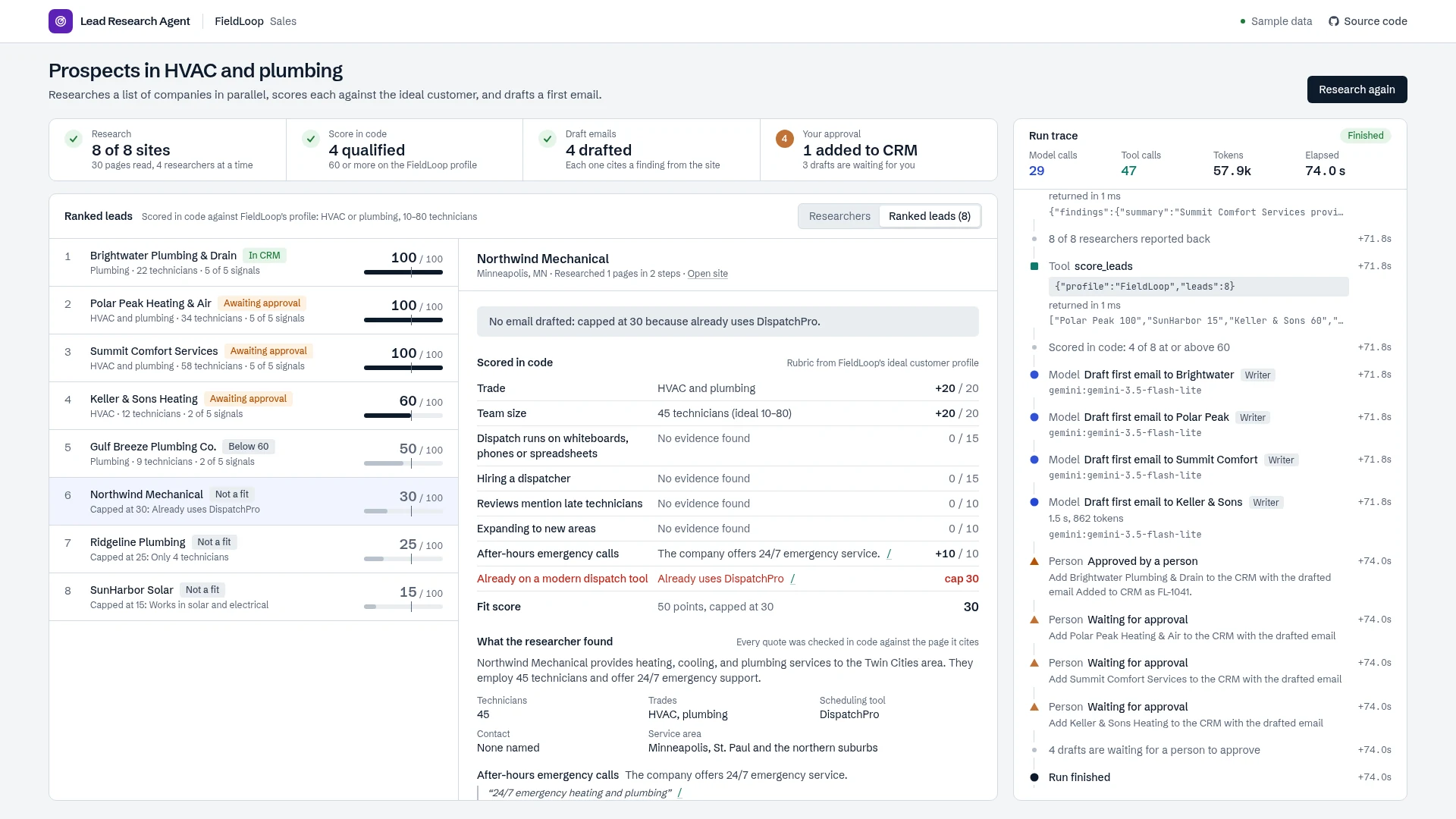
- ✓A rubric from the ideal customer profile scores trade, team size and buying signals; disqualifiers cap the score.
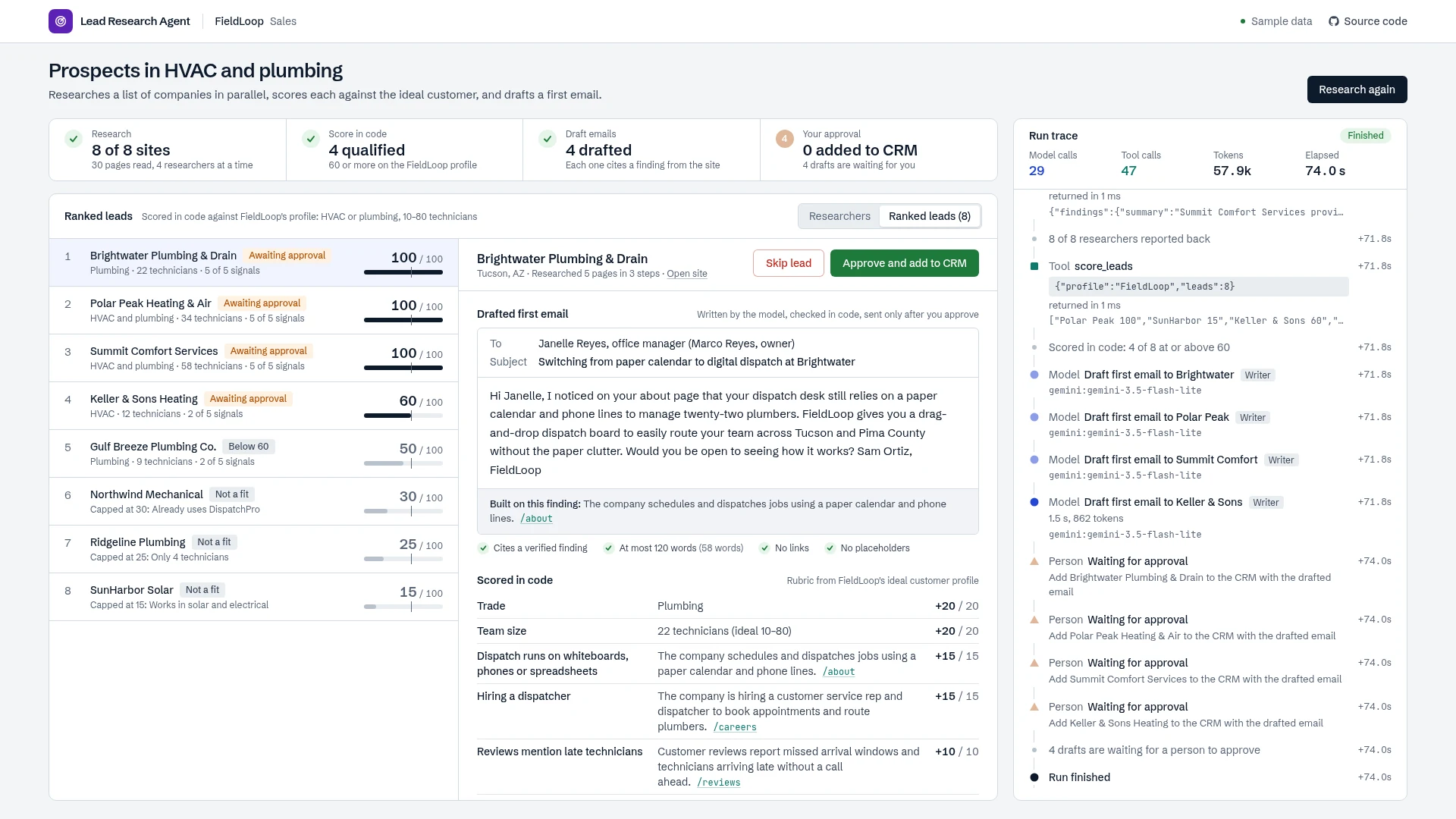
- ✓Drafts are checked in code for the cited finding, length, links and placeholders before a person sees them.
Architecture
Orchestrator, worker pool, evidence layer and writer, all streaming tagged events so the UI shows who is doing what.
Orchestrator & pool
A bounded worker pool runs the researchers; one failing or rate-limited worker never sinks the batch.
Researcher sub-agents
Tool loops with list_links, fetch_page and a submit_findings stop tool, fetching over real HTTP with an origin and path allowlist.
Evidence & scoring
Quote verification and a points-based rubric with caps, both pure functions with line-by-line tests.
Writer & CRM
A stronger model drafts; code validates; approved leads go through a CRM adapter that refuses duplicates.
Key Features
Live fan-out
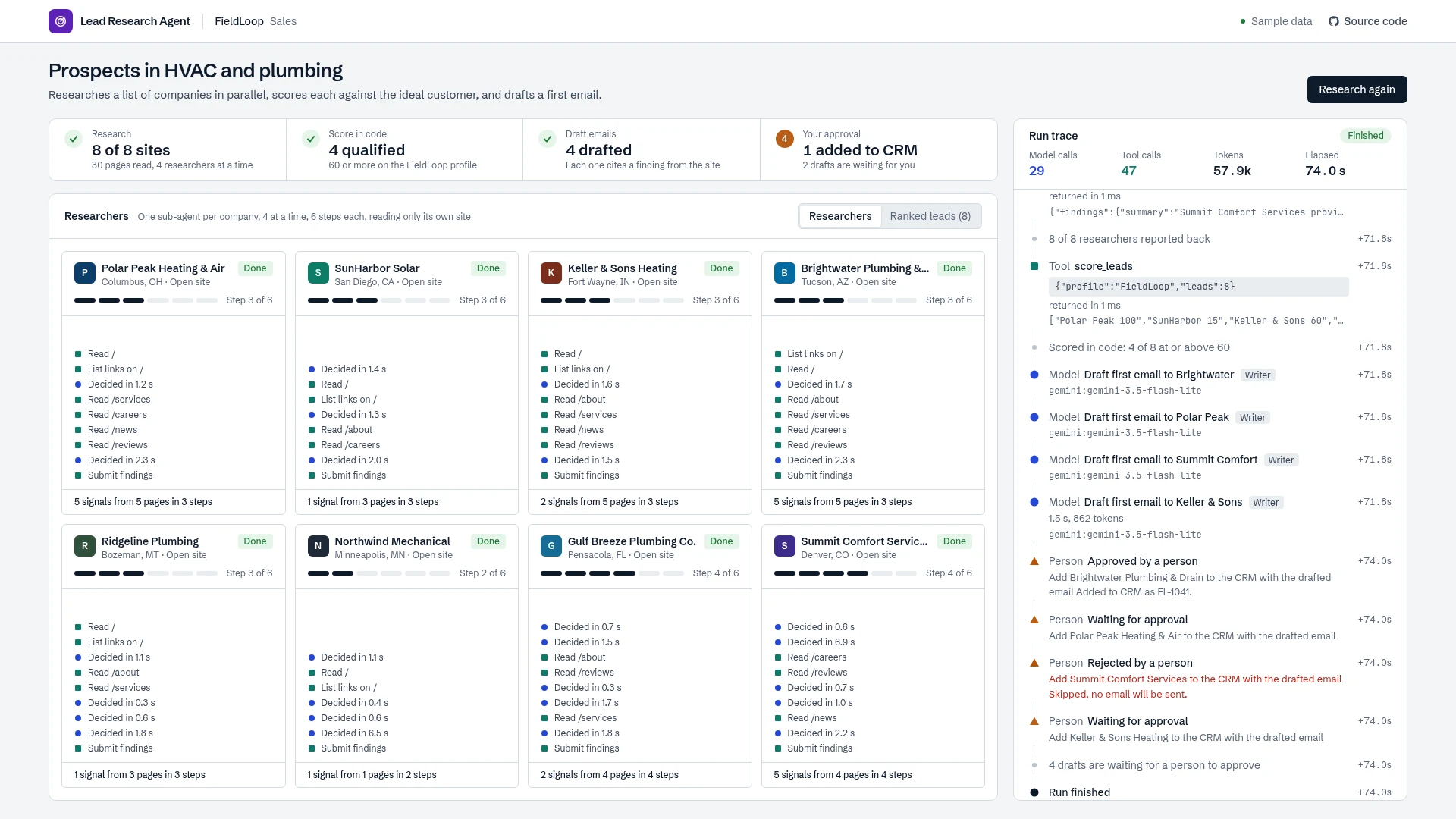
Eight cards show each researcher's current page and step budget as they work in parallel.
Every claim sourced
Buying signals come with the exact quote and a link to the page it was found on.
Explainable scores
Scores come from a rubric in code, with the reasons and any disqualifier cap shown.
Approval before CRM
Approve and add to CRM, or skip. Both are logged.
Technology Stack
Design & Engineering
Designed the orchestration, evidence and scoring model on the shared Agent Lab runtime, and directed the build.
- ▪Defined the ideal customer profile, rubric and disqualifier caps.
- ▪Wrote eight fictional company websites with specific, quotable buying signals and three deliberate poor fits.
- ▪Specified sub-agent isolation, step budgets and the quote-verification contract.
- ▪Reviewed the fan-out interface so the parallel work reads clearly on screen.
Product UI
Technical Challenges
Grounded outreach
Challenge: A single invented detail makes a cold email worse than no email.
Solution: Quotes are verified against fetched pages before scoring, and the writer may only build on a verified finding, checked again in code.
Parallel workers, one quota
Challenge: Four workers share one model quota and hit rate limits at the same moment.
Solution: Jittered backoff that honours the provider's retry delay, and per-company failure isolation so the batch always completes.
Keeping agents on their own site
Challenge: A researcher following links could wander to other sites or be redirected.
Solution: The fetcher only allows the company's own origin and path, refuses redirects and non-HTML, and each researcher's tools are scoped to its company.
Outcomes & Highlights
On the sample list the agent ranks the three strong fits at the top, caps the three poor fits for the right reason, and drafts emails only where they are earned.
- ✓Eight companies researched in parallel in about 45 seconds.
- ✓Four drafts, each built on a verified quote from the prospect's own site.
- ✓Poor fits capped: a competitor customer at 30, a four-person shop at 25, a solar installer at 15.
- ✓End-to-end tests run all eight companies offline against a scripted model.
- 8
- Companies researched in parallel
- 100%
- Quotes verified
- 0
- CRM entries without approval
About 45 seconds
Against the pages actually read
Approve or skip, both logged